


I am Suraj Singh an entrepreneur innovator, and visionary with a passion for technology, business, and creating meaningful connections.
Loading
I am Suraj Singh an entrepreneur innovator, and visionary with a passion for technology, business, and creating meaningful connections.
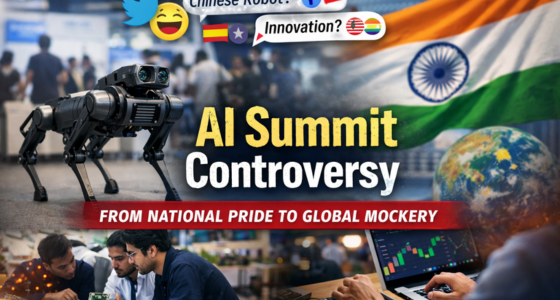
India’s Global AI Summit was intended to be a milestone event, showcasing the country’s growing strength in artificial intelligence, robotics, and emerging technologies. Delegates, companies, startups, and technology leaders from across the world gathered to witness how India is positioning itself in the rapidly evolving AI landscape.
However, instead of discussions around innovation and progress, the summit suddenly became the center of an unexpected controversy that shifted global attention away from genuine technological achievements.
At the heart of the issue was an exhibition stall run by Galgotias University, a private university participating in the summit. During media interactions, a robotic dog displayed at the stall was introduced as an AI robot developed by the institution’s own research center. Video clips of the presentation soon circulated online.

Technology observers and viewers quickly pointed out that the robotic dog was not an indigenous innovation but a commercially available Chinese-made robot already known in global robotics markets. Within hours, the clip spread across social media platforms, tech communities, and international forums.
What began as criticism of a single claim soon transformed into something much larger. Online commentary shifted from questioning one university’s presentation to mocking India’s AI ecosystem as a whole.
Social media platforms saw users from multiple countries sharing clips and making sarcastic remarks, suggesting that India was showcasing imported technology as domestic innovation. International media outlets also began reporting the incident, further amplifying the controversy.
The narrative moved away from the institution involved and began targeting the country’s broader technological credibility. Instead of celebrating Indian startups, engineers, and companies working hard to build AI products, the global conversation started questioning whether India’s innovation claims were genuine.
This is where the real damage occurred.
In global technology events, representation matters. Every participant becomes, in some sense, a representative of the country’s innovation ecosystem. When claims are made on international platforms, they are not seen as isolated statements but as reflections of national capability.
As a result, when the robotic dog controversy emerged, the embarrassment did not remain limited to Galgotias University. The online mockery and criticism began affecting perceptions of India’s broader AI efforts.
Meanwhile, many genuine Indian startups and companies were showcasing real innovations at the summit—AI solutions, robotics platforms, data technologies, and automation tools developed through years of work and investment. But their achievements received less attention as the controversy dominated headlines.
Following the backlash, Galgotias University issued a clarification stating that the misrepresentation resulted from incorrect communication by a representative who was not fully aware of the product’s origin. The institution emphasized that there was no deliberate attempt to mislead the audience.
But by then, the controversy had already spread globally. In the digital era, perception travels faster than correction.
For many observers abroad, the incident reinforced doubts rather than offering clarity. And unfortunately, the spotlight had already shifted from innovation to embarrassment.
While the controversy surrounding the AI Summit may appear to be a single institutional mistake, its consequences extend far beyond one organization. The deeper issue lies in how actions driven by publicity or commercial gain end up affecting companies and researchers who are genuinely working to build technology.
Innovation is not created overnight. Companies investing in artificial intelligence, robotics, and data technologies spend years developing products, training teams, testing systems, and building credibility. Such work requires patience, capital, and technical expertise.
However, when organizations attempt to gain attention by presenting borrowed or imported technology as their own innovation, they create a dangerous ripple effect. Once exposed, global audiences begin to question not just the organization involved but also others working in the same ecosystem.
And this is where genuine innovators suffer.
For startups and technology firms genuinely working in AI, trust is their most valuable asset. International partnerships, investor confidence, and customer adoption depend heavily on credibility.
When controversies like this surface, international observers often begin to doubt broader claims coming from the region. Investors and partners become cautious, asking tougher questions and demanding greater proof, even from companies with legitimate products.
As a result, honest innovators find themselves forced to re-establish credibility despite having done nothing wrong. The efforts of years suddenly come under suspicion due to the shortcuts taken by a few.
In the global technology industry, reputation is rarely individual. Countries are often judged as ecosystems rather than as separate companies or institutions. A single misrepresentation at an international platform can impact how an entire nation’s innovation capabilities are perceived.
The recent incident shifted global conversation from India’s real progress in AI to doubts about authenticity. Instead of discussing new startups, research breakthroughs, or indigenous solutions, international commentary focused on the controversy.
This shift harms not only businesses but also young researchers, developers, and entrepreneurs working to build careers in technology.
The controversy should serve as a wake-up call for institutions and organizations participating in global events. Publicity and branding cannot replace genuine innovation. Claims must be backed by real work and transparent communication.

India’s technology ecosystem is growing, and many companies are investing heavily in AI and robotics. These efforts deserve recognition. But protecting that reputation requires responsibility from every participant representing the country on global platforms.
Short-term publicity may attract attention, but long-term success depends on trust. When greed or desperation leads to exaggerated claims, the damage spreads far beyond the organization responsible.
The lesson is clear: authenticity and ethical representation are not optional—they are essential.
Because when the greed of a few leads to misrepresentation, the work of many ends up being questioned. And rebuilding global trust always takes far longer than gaining momentary attention.
Linkedin Article Post link: When One Incident Turns Into a National Question — Understanding the AI Summit Controversy

0 Comments