


I am Suraj Singh an entrepreneur innovator, and visionary with a passion for technology, business, and creating meaningful connections.
Loading
I am Suraj Singh an entrepreneur innovator, and visionary with a passion for technology, business, and creating meaningful connections.
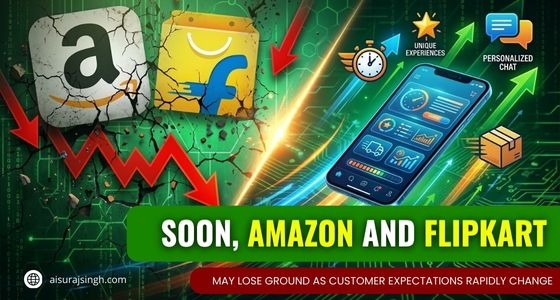
For more than a decade, online marketplaces like Amazon and Flipkart have dominated India’s e-commerce ecosystem. Their promise was simple: a massive selection of products delivered to your doorstep within a few days—sometimes even the next day.
But the dynamics of online shopping are changing rapidly. The rise of quick-commerce platforms such as Blinkit, Swiggy Instamart, and Zepto is fundamentally altering how consumers think about delivery speed, reliability, and value.
Today’s customers no longer evaluate online shopping purely on price or product availability. Instead, they increasingly prioritize how fast, how reliably, and how conveniently a product arrives. This shift in expectations could gradually weaken the position of traditional marketplaces that operate on slower delivery models.
Traditional e-commerce platforms built their reputation on logistics networks capable of delivering products within one to three days. However, that benchmark is quickly becoming outdated.
Quick-commerce platforms now promise delivery in 10 to 30 minutes for everyday essentials. This dramatic difference in speed has reshaped consumer perception of what “fast delivery” means.
According to industry estimates:
These services operate using dark stores and micro-warehouses located inside cities, enabling them to deliver items within minutes rather than hours or days.
As a result, traditional delivery timelines that once seemed impressive now feel slow to many customers.
Beyond speed, delivery reliability has become a critical factor affecting customer trust.
Many online shoppers report experiences where deliveries scheduled for a particular time window arrive much later than promised. For example, an order expected before noon may end up arriving in the evening.
In other cases, customers report receiving delivery updates claiming:
These messages are sometimes sent even when the customer is reachable and actively waiting for the delivery. Some customers also report delivery calls being declined or not returned when they attempt to contact the delivery partner.
When a customer orders something specifically because the platform promised delivery at a certain time, missing that commitment can damage trust.
And in e-commerce, trust is everything.
Interestingly, research shows that consumers increasingly prioritize reliability and cost over just speed.
A global consumer survey by McKinsey found:
This means the problem for large marketplaces is not only about speed.
It is also about meeting delivery commitments consistently.
If a platform promises delivery at a certain time, customers expect that promise to be honored.
Consumer behavior is evolving in two clear directions.
Platforms like Blinkit or Swiggy Instamart are becoming the default option for everyday items such as:
If these products can arrive within 10–15 minutes, many consumers see little reason to wait hours or days.
When customers know they must wait one or two days for delivery, price becomes the primary factor.
Platforms like Meesho have gained traction by offering extremely competitive prices, often close to wholesale rates—even for single products.
In such scenarios, consumers may ask:
“If I already have to wait two days, why not buy it at a cheaper price?”
This creates a strategic challenge for traditional marketplaces.
The biggest risk for traditional marketplaces is being caught between two strong alternatives.
On one side:
Quick commerce platforms
On the other side:
Low-cost marketplaces
This leaves companies like Amazon and Flipkart positioned in the middle:
In competitive markets, being stuck in the middle can be dangerous.
Another factor accelerating this shift is the rapid development of urban logistics infrastructure.
In India, several improvements are making faster deliveries possible:
These advancements are enabling newer platforms to deliver goods faster and more efficiently than traditional centralized warehouse models.
As logistics technology improves, consumer patience continues to shrink.
The modern online shopper behaves very differently from shoppers a decade ago.
Today’s customers:
In a market where alternatives are only one click away, even small frustrations—such as missed delivery windows or inaccurate delivery updates—can push customers toward competing platforms.
Amazon and Flipkart still dominate India’s e-commerce landscape, and their logistics networks remain among the largest in the country.
However, the emergence of quick commerce and low-cost marketplaces signals a larger transformation.
If delivery reliability issues persist and customer expectations continue to rise, these giants could gradually lose their advantage.
The next phase of e-commerce competition will not just be about who sells the most products, but about who delivers the best experience.
And in today’s digital economy, experience often matters more than scale.
Read also this:–
Meet Avidia AI: How Aayan Infotech Is Making AI Accessible to All (No Paid Tools Needed)
Where Can I Exchange Foreign Currency? Step-by-Step Complete Guide

0 Comments